
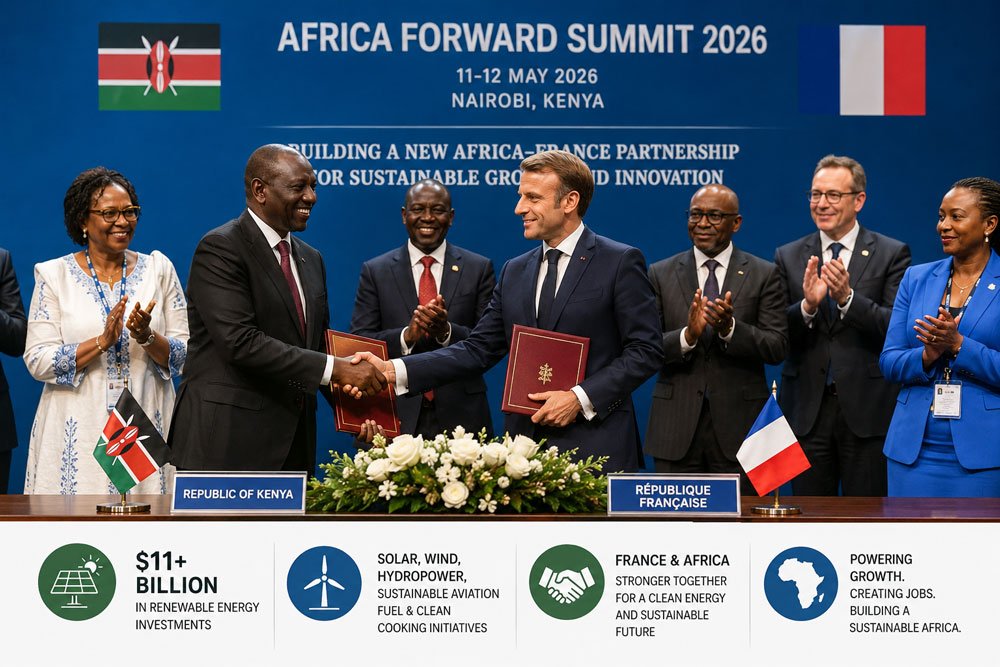
African and French leaders have announced a major clean energy investment push in Nairobi, marking a significant step in efforts to position Africa at the center of the global green transition.
The commitments were unveiled during the Africa Forward Summit 2026, held in Nairobi, Kenya, on 11 and 12 May 2026. The summit was co-hosted by Kenyan President William Ruto and French President Emmanuel Macron, and brought together African heads of state, business leaders, investors and innovators under the theme of building a more equal Africa-France partnership.
According to the Associated Press, more than $11 billion in renewable energy investments were announced during the summit, covering projects in sustainable aviation fuel, hydropower, solar energy, wind generation and clean cooking. The wider investment package announced by Macron was valued at €23 billion, or around $27 billion, with €14 billion expected from French companies and €9 billion from African entities.
A new energy partnership takes shape
The Nairobi summit was presented as more than a diplomatic meeting. It was framed as a shift from traditional aid-based relationships toward investment, co-development and industrial growth.
For Africa, the clean energy transition is not only about reducing emissions. It is also about expanding electricity access, developing local industries, creating jobs and ensuring that the continent benefits from its own natural and renewable resources.
Kenyan President William Ruto captured this message clearly at the summit, saying that Africa has an opportunity not only to participate in the global energy transition, but also to help lead it. He added that for Africa, the energy transition must also be an industrial transition.
That distinction matters. Africa has some of the world’s strongest solar, wind, geothermal and hydropower potential, but much of it remains underdeveloped. At the same time, millions of people across the continent still lack reliable access to electricity. The challenge is therefore not simply to produce clean energy, but to ensure it supports factories, transport systems, digital infrastructure, agriculture, and local economic growth.
Major deals announced in Nairobi
Among the headline announcements was an agreement between Kenya Airways and Rubis Energy to develop what the companies described as Africa’s first sustainable aviation fuel production facility in Kenya. The facility is expected to produce around 32,000 metric tons of sustainable aviation fuel per year.
Sustainable aviation fuel is seen as an important tool for reducing emissions in air travel, a sector that is difficult to decarbonize. For Kenya, producing this fuel locally could reduce dependence on imports while opening a new industrial opportunity linked to global aviation.
TotalEnergies also announced plans to spend $10 billion in Africa by 2030. This includes a $2 billion renewable energy project in Rwanda and $400 million for clean cooking initiatives in Kenya, Uganda and Tanzania. Clean cooking remains a major development and health issue across the continent, where many households still rely on traditional fuels that can contribute to indoor air pollution.
Other announced projects included a planned 2-gigawatt hydropower project by EDF, a $350 million commitment by Global Telecom for a 250-megawatt solar plant in Zambia, and a $200 million investment by Meridian to double the capacity of Kenya’s Kipeto wind project to 200 megawatts.
Together, these announcements suggest that international investors are increasingly looking at Africa not only as a market for energy projects, but as a strategic player in the future of global clean power.
Finance remains the biggest test
While the Nairobi announcements are significant, African leaders made clear that investment commitments alone are not enough. One of the summit’s most important themes was the need to reform how global financial markets price African risk.
African governments have long argued that the continent is often treated as a high-risk investment destination, even when projects are commercially viable. This can raise borrowing costs, slow infrastructure development and make it harder to finance major energy and industrial projects.
Reuters reported that African leaders used the summit to push for easier access to credit and a rethink of risk pricing. Macron also backed the idea of a first-loss guarantee mechanism to help de-risk investment in Africa and said he would promote the proposal at the G7 summit.
This is a central issue for Africa’s energy future. Renewable energy projects require long-term capital, and high financing costs can make projects more expensive or prevent them from moving forward. If financing becomes fairer and more accessible, Africa could accelerate the deployment of solar, wind, hydropower, clean cooking and industrial energy solutions.
From aid to co-investment
The Africa Forward Summit was also politically significant. France has been trying to reshape its relationship with Africa at a time when its influence has declined in parts of the continent, especially in former French colonies in West Africa. Holding the summit in Kenya, an English-speaking country that was not a French colony, reflected a wider attempt to build a new kind of partnership.
The official summit platform described the event as a partnership “built on equal ground,” with themes including energy, finance, agriculture, artificial intelligence, the blue economy, health and industrialization.
For African countries, the message is increasingly clear: partnerships must move beyond aid, extraction and symbolic diplomacy. They must deliver infrastructure, technology transfer, local jobs, industrial capacity and fair access to finance.
For France and Europe, the summit highlights Africa’s strategic importance in a changing global economy. As demand grows for clean energy, critical minerals, digital infrastructure and new consumer markets, Africa is becoming a central arena for international investment.
A good-news story with real-world challenges
The Nairobi energy package is encouraging, but the real test will be implementation. Large investment announcements often take years to translate into completed projects. Questions remain around financing terms, environmental impact, local ownership, job creation, procurement transparency and whether communities directly benefit from the projects.
Still, the direction is important. The summit showed that Africa’s clean energy future is no longer being discussed only as a development issue. It is increasingly being treated as an investment, industrial and geopolitical priority.
If the announced projects move forward, they could help expand clean power, reduce reliance on imported fuels, support new industries and strengthen Africa’s role in the global energy transition.
Protein fibers: another sustainability breakthrough
The Good News report also highlighted a separate innovation in sustainable fashion: recyclable protein-based textile fibers developed by engineers at Washington University in St. Louis.
The research focuses on materials produced in bioreactors using genetically engineered microbes. According to Phys.org, the protein-based fibers can be recycled after use and remade into the same fibers over multiple cycles. Any microparticles released during washing would also be biodegradable, which could help reduce microplastic pollution from clothing.
This development is still at the research stage, not yet a mass-market replacement for polyester, nylon or cotton. However, it points to a promising future for fashion, where textiles could be designed from the start to be recyclable, biodegradable and less harmful to the environment.
The bigger picture
From renewable energy deals in Nairobi to protein-based fibers in the lab, the broader message is one of practical innovation. Governments, companies and researchers are no longer only talking about sustainability. They are beginning to build the systems, materials and partnerships that could make it work.
The Nairobi summit is especially important because it places Africa at the heart of that transformation. The continent is not simply a destination for outside investment. It is a source of solutions, markets, talent and renewable potential.
The coming years will show whether the pledges made in Nairobi become real projects on the ground. But the signal is clear: Africa’s clean energy future is moving from promise to strategy, and the world is paying attention.